
Summer in DC is not for the faint of heart. Especially in the relatively treeless heart of our city.
Citizen scientists fanned out across DC and Baltimore over three days in August 2018 to measure temperatures throughout the city. Portland State University researchers then used their data to map out the “urban heat island” effect. What they found was a 17-degree difference between the hottest and coolest areas of the city.
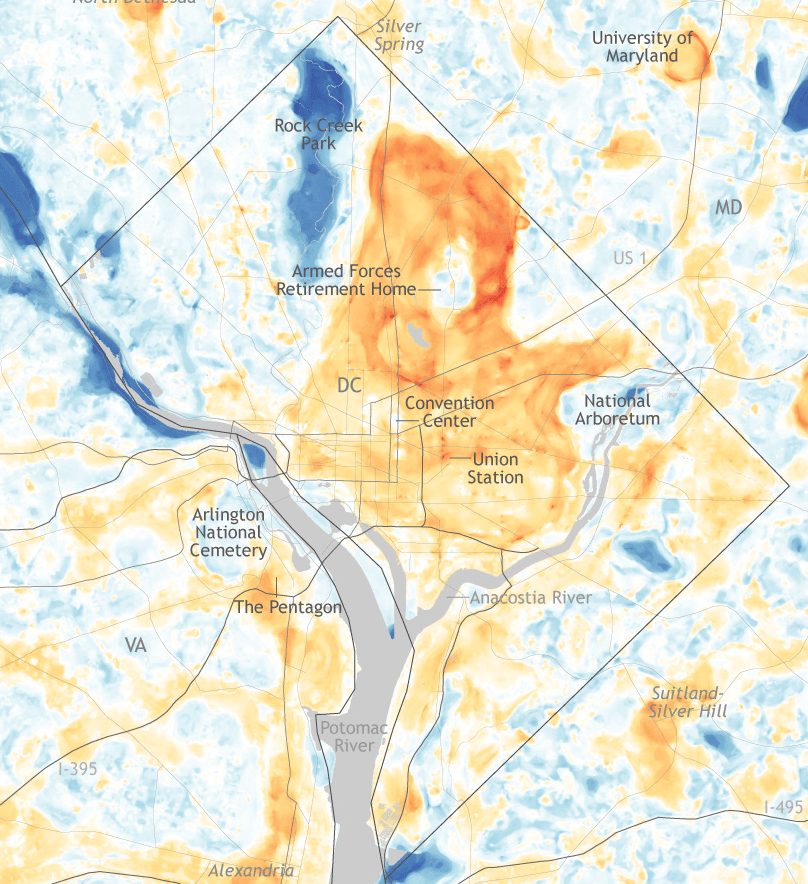
Now compare the image to this interactive map of DC trees.
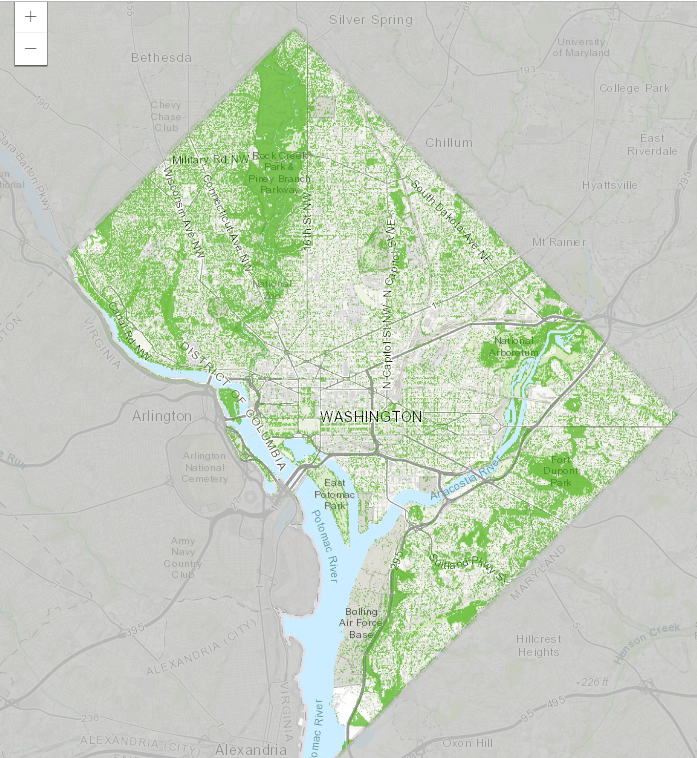
It confirms what we all know to be true: Where we have ample shade from trees, we have cooler temperatures. And in this part of DC, we are fortunate to have oaks, tulip poplars, maples and other large, mature trees that keep the sun off our homes and streets and keep us relatively cool during the summer months.
Unfortunately, our trees are at risk. Sources of stress include erosion, extreme weather conditions, pests and invasive plants, pruning to protect electrical lines, and other utility work. (The DC Water sewer pipe relining in Soapstone Valley is a major upcoming project.)
We’re not helpless, however. It helps to understand the local laws and regulations, the role of government agencies and organizations, and what private property owners can do.
A protective canopy of laws and regulations
The trees of Forest Hills are offered more protection than most outside of Rock Creek Park. More than a decade ago, the Forest Hills Citizens Association, under the leadership of former president George Clark, pushed for the Forest Hills Tree and Slope Overlay District. Clark told Forest Hills Connection in 2012 that its purpose was to “preserve the natural topography and mature trees in the neighborhood, prevent adverse impact on open space, parkland, streams and environmentally sensitive areas, and limit permitted building and impervious ground coverage.”
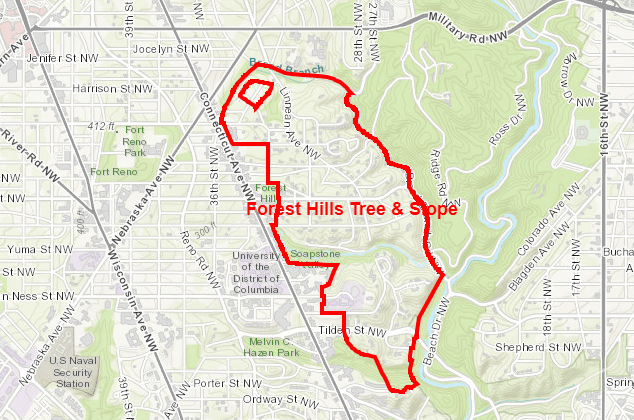
Within the overlay district, only 30 percent of a lot can be occupied and the minimum lot size is 9,500 feet. Any tree removal must be approved by the Department of Transportation’s Urban Forestry Division, which has 20 arborists on staff.
Throughout the District, the law protects large trees on private property. A property owner must get a permit from the city to cut down a “special tree,” between 44 inches and 99.9 inches in circumference. The cost of the permit is $55 per inch of circumference.
Larger trees are considered “heritage trees” under the law, and cannot be cut down unless a certified arborist determines it to be a hazard. Cutting down such a tree without permission brings a fine of at least $300 per inch of circumference.
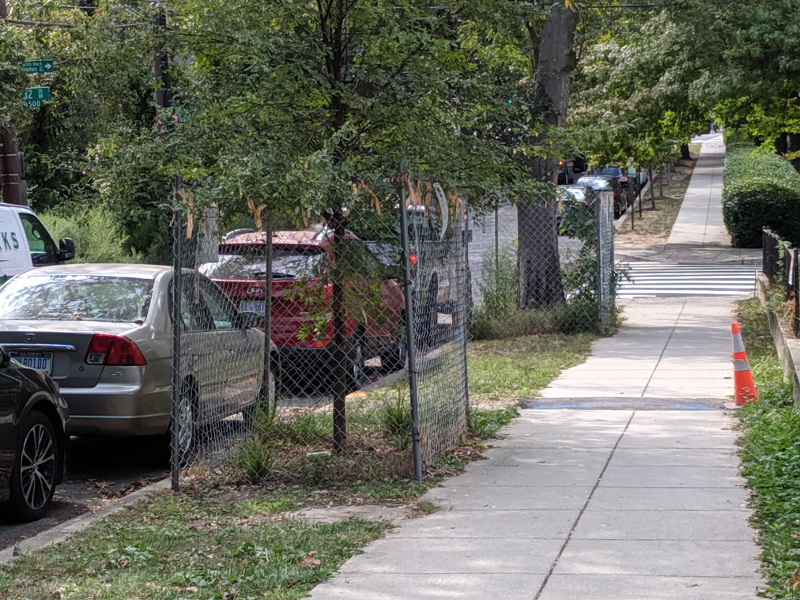
In addition, street trees must be protected from construction by a six-foot-high chain link fence.
The agencies responsible for tree care: Urban Forestry, DOEE, Casey Trees
Urban Forestry, a division within the DC Department of Transportation, protects and maintains our street trees. It is responsible for pruning, removing and planting the trees.
And it is well aware of the benefits of a healthy urban forest. Urban Forestry’s website lists benefits including improved air quality, temperature moderation, aesthetics and increased ground water retention that minimizes runoff and flooding.
This brings us to another important government service: RiverSmart, a program of the DC Department of Energy and Environment more closely associated with reducing stormwater pollution. Its mission also includes tree planting. RiverSmart partners with Casey Trees, a nonprofit organization dedicated to protecting and increasing our tree canopy. Casey Trees’ goal is to get the District’s tree cover to 40 percent by 2032, from 35 percent in 2011. Through Casey Trees, you can get rebates or sign up to get trees planted.
What private property owners and neighbors can do
Property owners have an important role to play in maintaining and growing our tree canopy on their properties, in public space and on national park land.
Trees within our yards need care and maintenance to protect your home and your neighbors’ properties. This requires an experienced arborist. A regular checkup is a good idea. An arborist can see things the homeowner can’t. Consulting arborists can be found via their trade group’s website or ask a neighbor whom they use.
The property owner also should routinely check for dead branches, how large they are and whether they can pose a threat to other landscaping, fences, and yours and neighbors’ homes. You can also check for leaves turning brown before fall. This is happening to a number of white oaks this season.
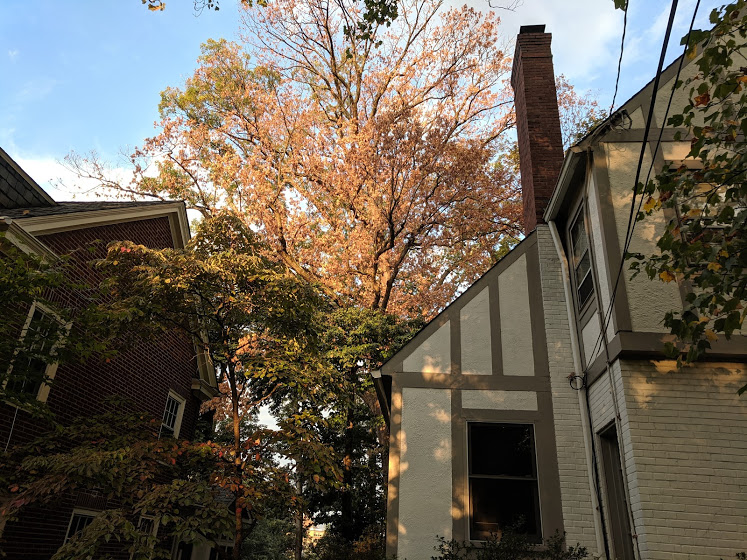
The stress of previous wet seasons followed by months of hot dry weather has put these trees at serious risk.
Other warning signs include crevices in the trunk of the tree, bark falling away from the tree, leaves not dropping in autumn, and space under the base of tree. Urban Forestry’s website lists common diseases and their symptoms.
Another thing property owners can do is keep young trees well watered, whether Urban Forestry planted them – or you did. Unless there has been a recent soaking rain (cloudbursts do not count), a tree planted in tree box areas next to the street needs to be watered once a week for the first two summers of its life, and perhaps longer if the weather is hot and dry. You can sign up for a weekly watering alert from Casey Trees which tells you whether we’ve had enough rain – or not.
Young trees will not survive without this TLC. If you have a tree in front of your house with a green watering bag wrapped around it, please water.
When you notice a street tree is dead, dying or in need of water, contact 311. It can be easier to call this request in. Be sure to have the address if it is not in front of your property.
Trees on national parkland
The trees of Rock Creek Park and adjoining parkland such as Soapstone Valley and Melvin Hazen Park can also succumb to dry conditions and disease. But here, invasive plants are a constant problem, and English ivy and other vines climbing up the trees are a particular hazard. Neighbors can volunteer through Rock Creek Conservancy to remove invasive species. Contact Rock Creek Conservancy to learn more about volunteer programs.
And we humans, despite our love for the trees and the shade they provide, pose another threat. Well over a century ago, the city installed a sewer system in the Soapstone Valley. DC Water plans to rehabilitate those aging pipes, and could remove as many as 297 trees in the process. Forest Hills Connection will continue to provide updates on this project.
October is Tree Month on Forest Hills Connection. Coming up: The science behind the benefits of growing and protecting our tree canopy, and more about the dying oak trees.
Discover more from Forest Hills Connection
Subscribe to get the latest posts sent to your email.