
by David Jonas Bardin and Marjorie L. Share
Hikers did not notice. Nor did nearby homeowners, and it seemed an accident, almost, that anyone did.
The amount of sewage seeping from the ground near Soapstone Creek – beyond where the east end of Audubon Terrace meets the Soapstone Valley Trail – was small and intermittent. The seep was 1,900 feet downstream from the trailhead at Albemarle Street.
This story is about how, in 24 days, DC Water confirmed and repaired the small leak.
Discovery and confirmation
This nearly unnoticed leak was spotted last year by an alert storm water inspector for the District Department of Energy and Environment (now DOEE, after a name change in August). She or he reported to DOEE, DC Water (DCW) and the Park Service that a liquid sometimes oozed out of a hillside overlooking Soapstone Creek. DCW, which had a sewer pipe buried inside that hillside at a shallower depth than the ooze, then reported a “possible” overflow to the EPA, but DCW did not repair the pipe.
Months later, on Monday, July 13th, DC Water engineer Bisrat Abebe, who manages big sewer design projects for Soapstone and elsewhere, heard an NPS description of the issue and wasted no time in alerting DCW’s emergency team. The Park Service took DC Water personnel to the site.
Before any fix, DCW would need to confirm that it was, in fact, sewage oozing from a DCW pipe in the hillside and locate the pipe segment that was its source. A dye test would do both simultaneously, and Abebe arranged for it to be done that very day. DCW inspectors poured a concentrated green dye into a manhole upstream from the ooze site, and sure enough, green dye showed up in the ooze. That test identified the source as a particular sewer pipe east of Audubon Terrace and next to the forested Soapstone Valley Trail.

It was then that DCW knew it had a small leak in an 18-inch diameter, 1908 terra cotta gravity-flow pipe. It leaked at times of high flow but not at low flow, implying a leak on the side rather than bottom of the pipe – which subsequent video inspection verified. Intermittent leakage likely made finding the leak difficult.
Although a DCW video inspection of that very pipe in June 2010 had found cracks and roots, and it had been reported as “broken,” DCW did not know of any actual overflow. So the condition did not rate emergency repairs under DCW’s guidelines. In addition, as an earlier Forest Hills Connection Article noted, the agency was just beginning its planning process to replace or repair the more than 7,000 linear feet of pipe running throughout the Soapstone Valley.
The temporary fix
On Tuesday, July 14th, DCW plugged the 18-inch diameter pipe running downstream from the last manhole at the eastern end of Audubon Terrace (Manhole A in the diagram below, where the pipes form a “Y”). That left open two upstream pipes bringing sewage into the plugged manhole. One was a 15-inch diameter, 1963 pipe laid under Audubon Terrace and the other, an 18-inch diameter, 1908 pipe running underground, parallel to Soapstone Valley Trail.
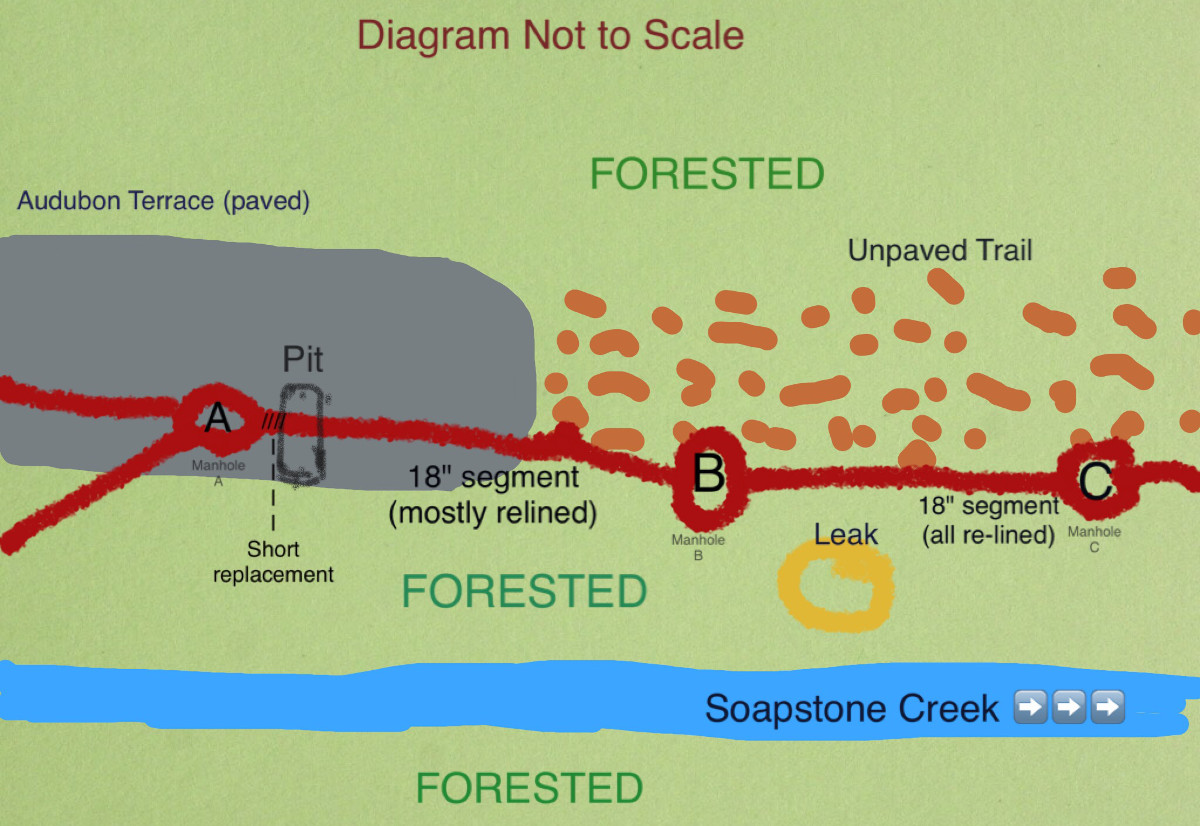
DCW installed a pump which sucked up sewage from that plugged manhole and poured it into a bypass hose laid out by hand on the surface along Soapstone Valley Trail. That bypass discharged its sewage into another, downstream manhole (Manhole C in the diagram).


Walking along the trail, one could hear sewage gurgling in the bypass and view the creek below. The sewer pipe being bypassed was buried deep below the trail. The ooze had been spotted somewhere on the hillside below the pipe elevation.

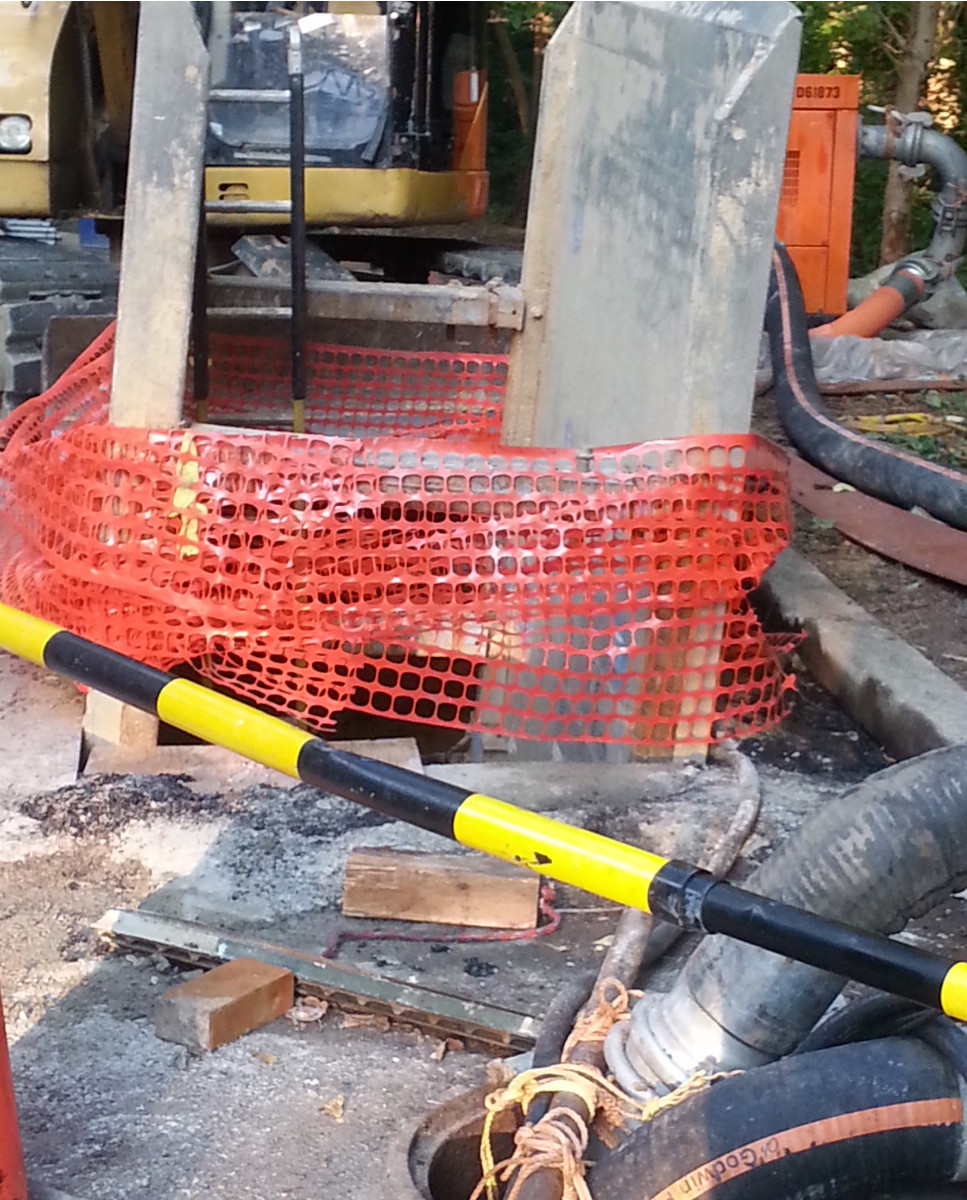
As a precaution, DCW planned a second bypass hose – seen rolled up on paving in the photo below – and installed it the next day, together with a backup pump.

DCW stood watch. It assigned round-the-clock on-site contractor personnel in 12-hour shifts, ready to turn on the backup pump should the primary pump fail.
Planning and preparing the long-term fix
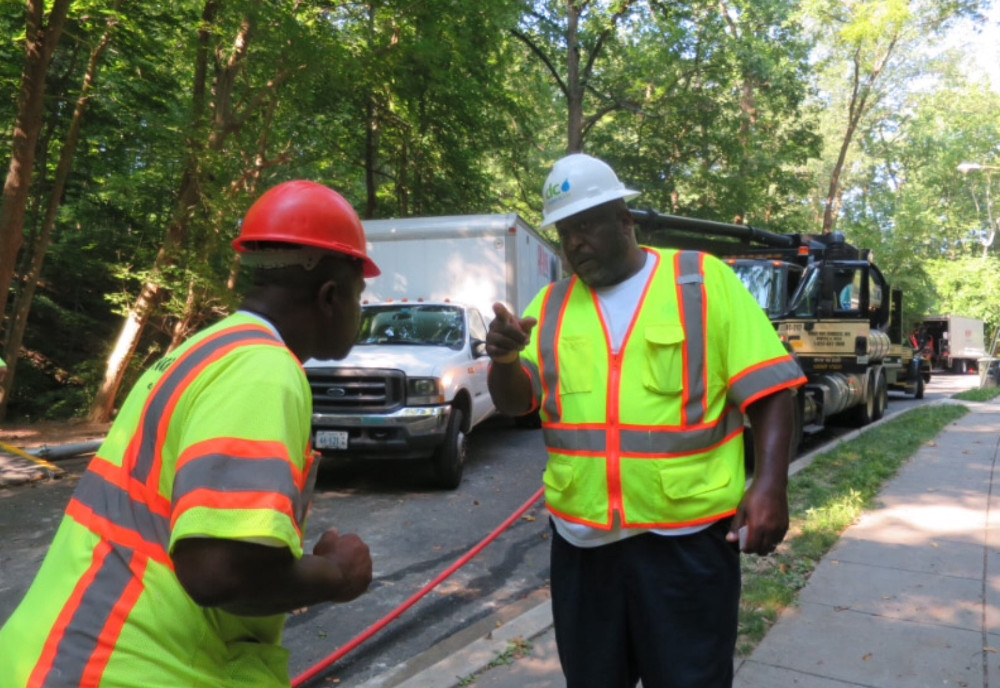
DCW planned and designed the temporary and the permanent fixes. To carry out both jobs, it turned to Anchor Construction, a standby emergency contractor, as its prime contractor, with subcontractors for specialized jobs. DCW’s John Crowder gave direction.
In weighing the repair options, DCW sought an approach that would minimize the impact of its repairs on the environment. Those options included replacing the leaky pipe between two manholes (B and C on diagram below) or lining that segment. Both manholes are in unpaved DDOT right-of-way east of Audubon Terrace and part of the Soapstone Valley Trail.
The temporary bypasses, beginning in Manhole A on paved Audubon Terrace, were what led DCW to a solution that minimized negative ecological impacts of long-term repair. For one thing, it chose to leave most of the old pipe where it was – and line it with cured-in-place pipe (CIPP).
DCW also chose to minimize its footprint by addressing two pipe segments instead of one. Crowder said DCW realized it could best avoid any impact on the unpaved trail by:
(a) installing CIPP with inversion technology (more on that below) and
(b) starting from a pit dug near Manhole A on paved Audubon Terrace instead of at Manhole B.
The latter would keep all staging, materials stockpiling and operation of repair vehicles and machinery on the paved area. None of this equipment would go onto the forested trail downstream. When they had to access downstream facilities, DCW and contractor personnel walked along the trail, carrying tools, hoses, and other materials by hand.
The inversion method of CIPP installation, furthermore, pushes the liner material through the “host” pipe, which requires machinery and staging equipment at only one end.
This video shows a CIPP installation by air inversion:
Another CIPP method, which DCW did not use in this case, would have fed the liner in at one end and pulled it through by machine (winching) at the other end.
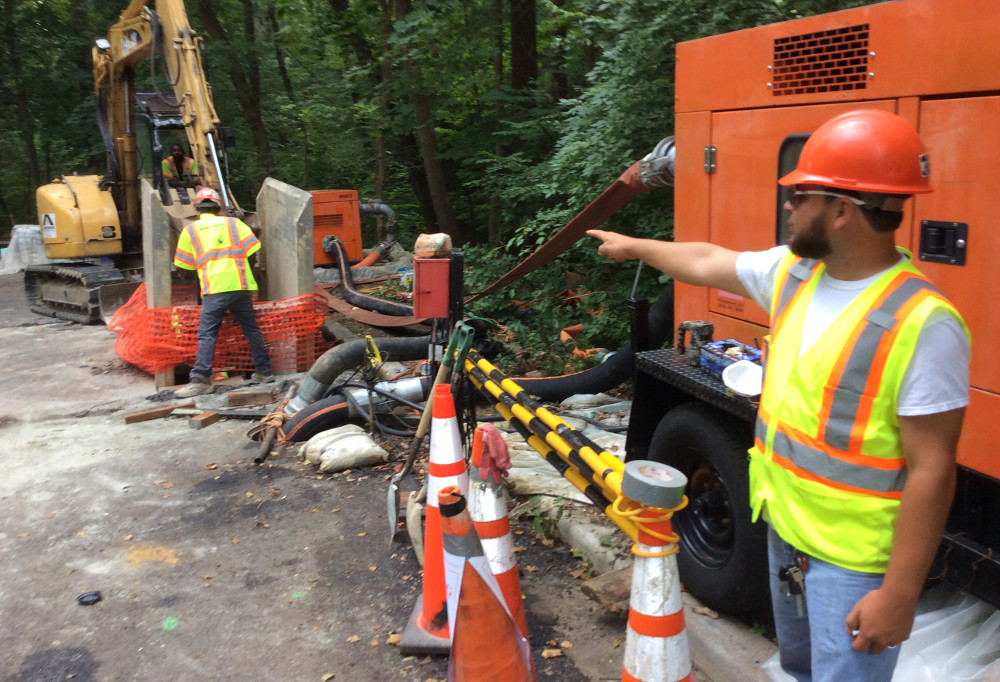
Just a few feet downstream from Manhole A, still plugged so the bypass pipe and pump could suck up sewage, DCW dug a work pit close to a dozen feet deep to access the now-unused sewer pipe.
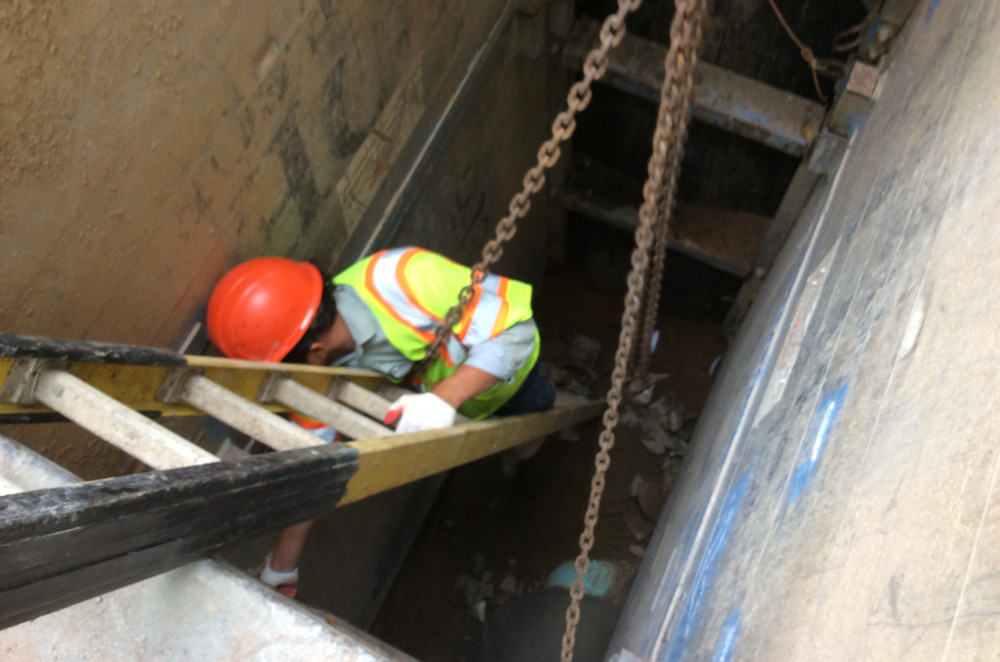
DCW replaced a short piece of the original 18-inch diameter terra cotta pipe leading from Manhole A with 18-inch diameter PVC pipe. Relining would begin in the pit and continue through Manhole B to Manhole C.
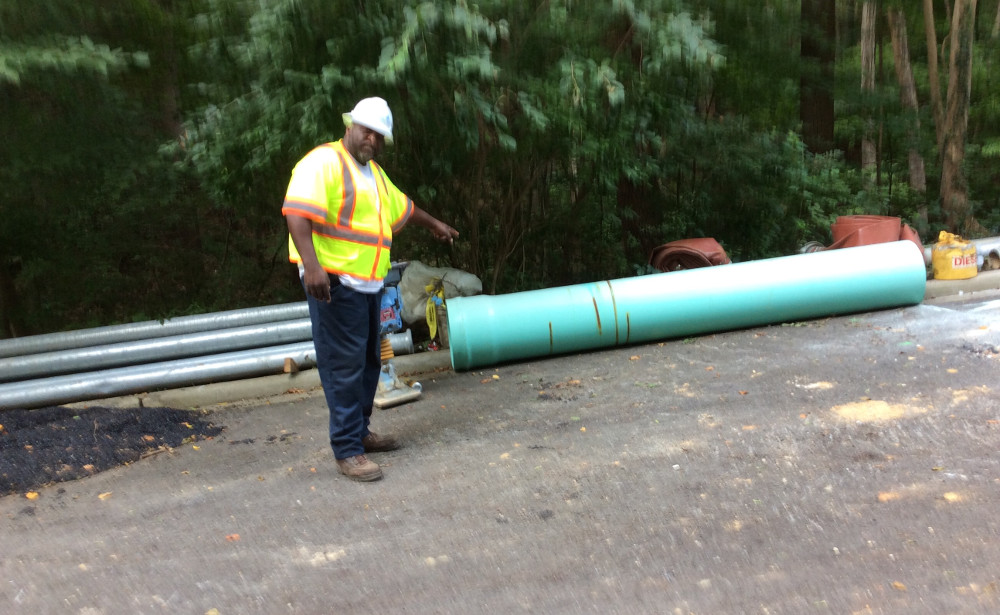
Subcontractor Video Pipe Services, Inc. inspected the 1908 terra cotta pipe for obstacles – such as tree roots – that would prevent tight adherence of liner material to the old pipe. It also cleaned out the pipe to be lined using high-pressure hosing.
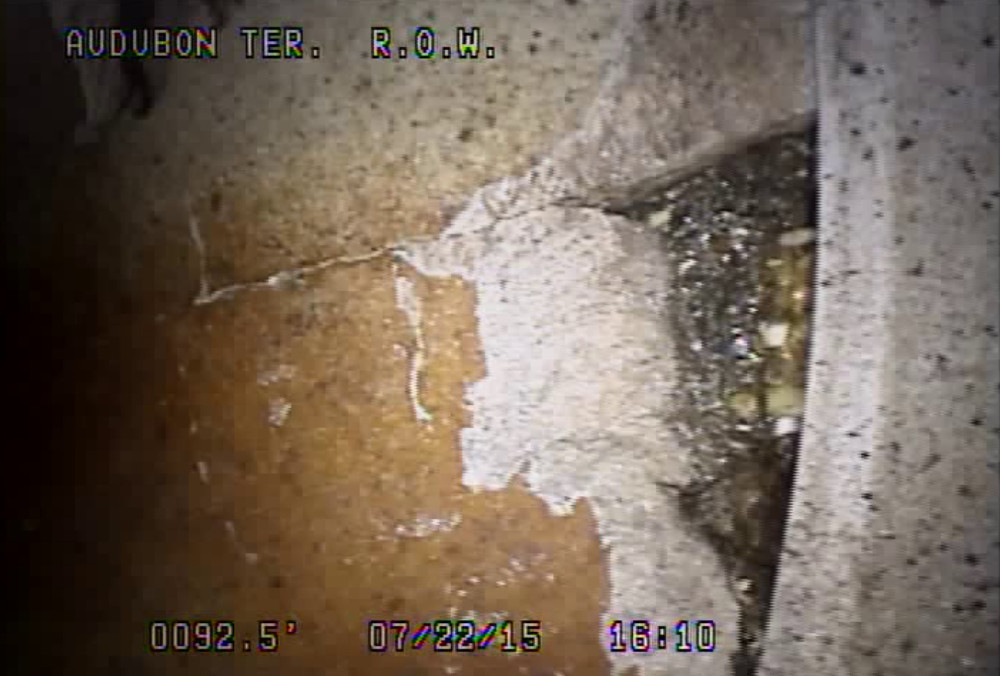
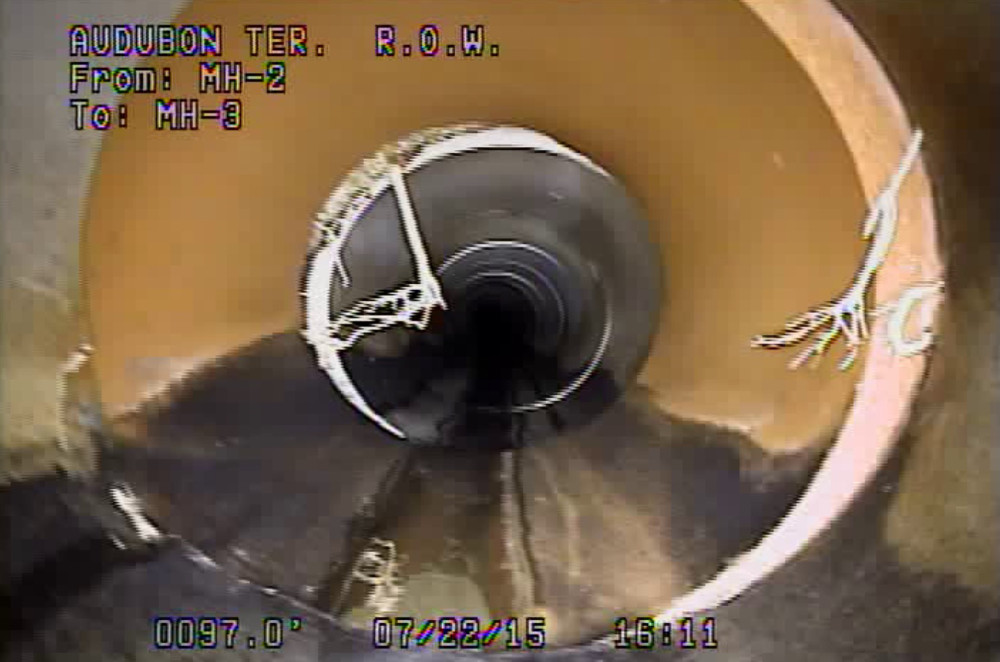
Another subcontractor, AM-Liner East, installed the heated CIPP liner via the work pit. Compressed air pushed the liner through the old pipe, and then the subcontractor sent steam through to cure the lining and adhere it to the walls.
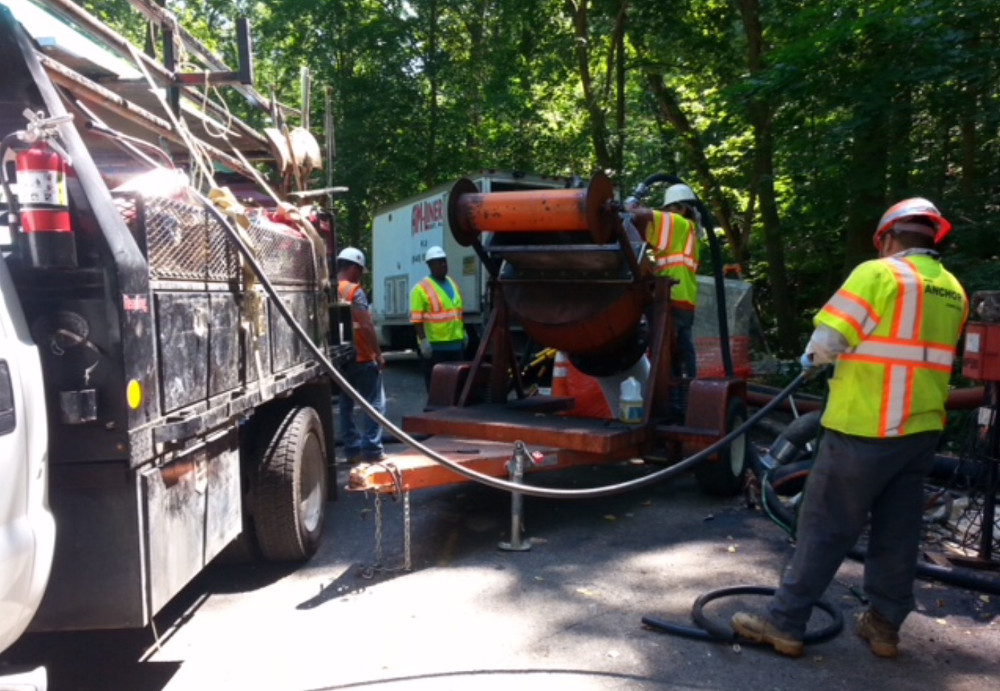
At each end of the PVC, a rubber sleeve over both pipes (called a Fernco coupling) was used to join the two different materials and it was covered with fresh concrete.
The repairs involved about 296 linear feet of pipe in all – out of the more than 7,000 feet of DCW sewer pipes in Soapstone Valley. Brian Hendricks of AM-Liner East said he had personally installed as much as 1,200 feet of liner in one shot with CIPP inversion methodology. He had heard of even greater lengths.
The finishing touches
Afterward, as DC Water’s Crowder explained, a video camera again inspected the newly lined pipe.
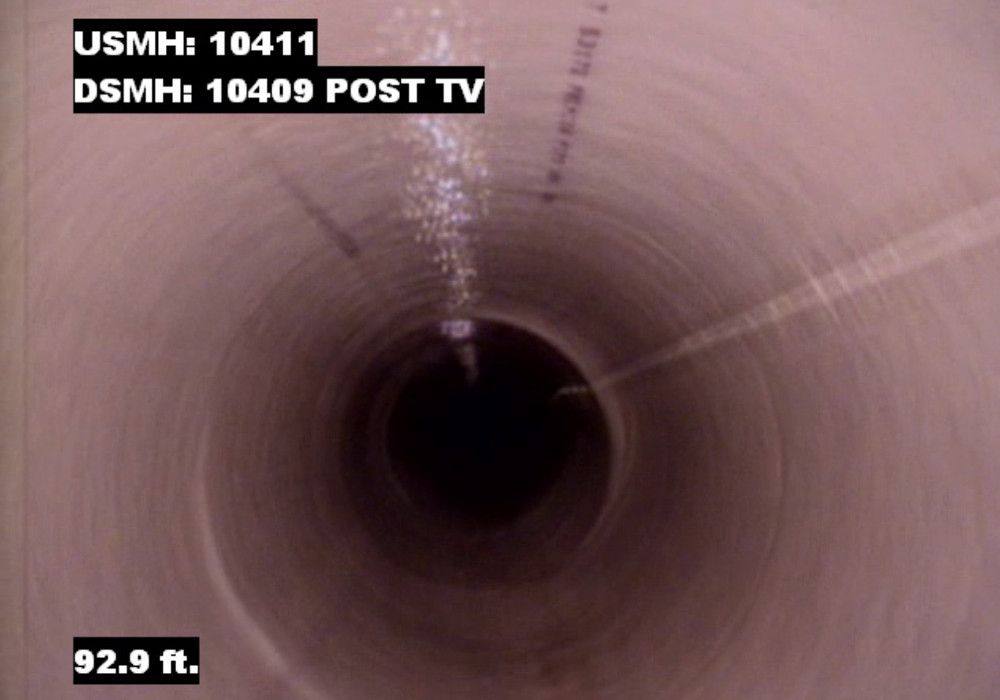
Then the relined segment was filled with water and dye for hours to assure that nothing leaked any longer.
On August 6th, DCW was ready to disconnect the bypass pumps, remove bypass hoses, unplug the downstream pipe leading from Manhole A, and allow resumption of regular sewage flow.
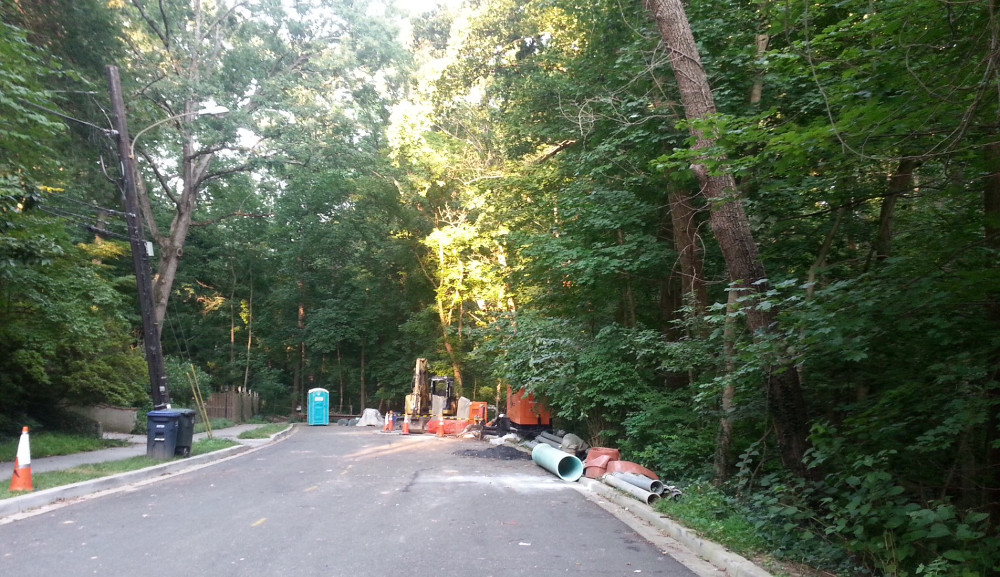
And on August 7th, DCW filled the pit, covered it with temporary asphalt paving, and removed tools, materials, and vehicles. In due course, a DCW contractor will permanently pave over the pit in accordance with DDOT standards.
So in 24 days, DCW responded, tested, put a team in place, and found solutions with minimal footprint and disruption to stop one small leak. Along the way, we found that DCW and its contractors were good about stopping to answer questions and sharing information on what they were doing with neighbors of the project.
The rest of the story – for now (Q&A)
Soapstone Creek is the subject of an ongoing E. coli contamination upstream, closer to Connecticut Avenue. The investigation, which started in 2014, will be the focus of a followup article, but here are some of the facts as described by the agencies involved.
Q. Did the leak detailed in the article above cause pollution of the Creek near Connecticut Avenue?
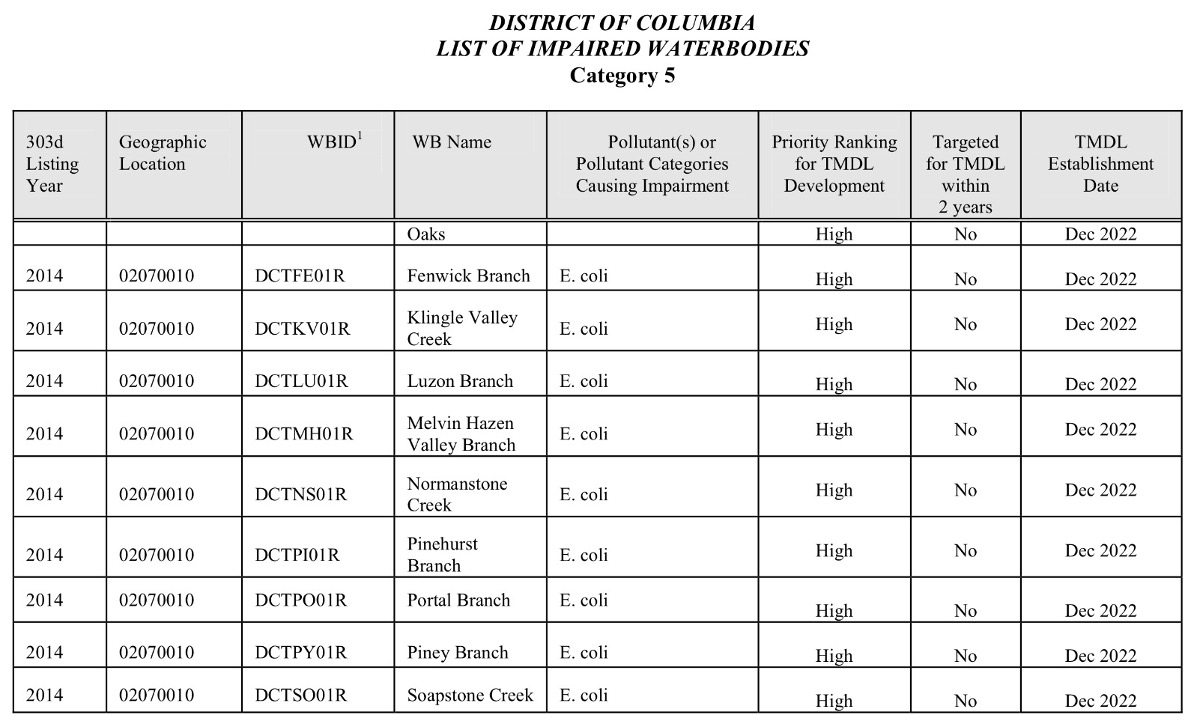
A. No. This small leak was far downstream from the area involved in ongoing investigations by DOEE, NPS and DCW, and therefore could not affect this part of Soapstone Creek. Those investigations concern impairment of creek water quality as evidenced by the presence of E. coli bacteria. Below you see part of page 279 of a 300-page DOEE report to Congress on DC’s water quality, posted online in January 2015.
Q. Was there a connection between the initial discovery of this small leak and other investigations?
A. There might well have been, but we have little specific information. Here’s what we do know:
The National Park Service informed us on August 13th: “The NPS became aware of the small leak near Audubon Terrace during an investigation, with DDOE, of a larger E. coli issue starting higher up in Soapstone Creek. It is our understanding that DDOE may have notified DC Water about this leak prior to the revelation about the larger E. coli issue. The NPS requested this leak be patched and that DDOE conduct additional water quality sampling on June 19. The small leak turned out to be in a location where a DC Water pipe had leaked previously – park staff recalls sometime in the 1990s – and was fixed. On July 13, the NPS took DC Water staff to this location and discussed the long term issues at that location.” NPS referred us to DDOE and DC Water for specifics.
DOEE (the agency’s name changed from District Department of the Environment (DDOE) to the Department of Energy and Environment (DOEE) as we worked on this article) informed us on August 18th: “The responsibility to notify NPS lies with DC Water. DOEE notified DC Water Sewer Services of the leak on October 29, 2014. DC Water notified EPA on October 30, 2014 of “a possible SSO” (Sanitary Sewer Overflow), while they continued their investigation. On October 31, 2014, DC Water sampled the seep and confirmed the presence of sewage via E. coli indicator bacteria. DOEE is not aware of when NPS was notified about the SSO.”
DDOE/DOEE wrote why they believed NPS asked DC Water to patch the leak on June 19th: “Although DOEE was not involved in any direct conversations between NPS and DC Water, based on our direct conversations with NPS, we believe this date to be accurate. Our follow up of the leak at Audubon Terrace (SSO) found that DC Water had not patched or addressed the leak [and] no further investigation of the seep had been conducted. DC Water’s initial investigation did not confirm any sanitary seepage; however, no further supporting documentation was provided. After sharing this information with NPS, and the discovery of elevated E. Coli near the outfall, NPS requested the patch.”
(DOEE’s seemingly contradictory statements (in bold) above, may well refer to distinct parts of DCW.)
Q. How might an alert DOEE inspector have discovered this leak?
A. DOEE regularly inspects storm water outfalls as required by the U.S. Environmental Protection Agency. One of those outfalls (F-140, south of Albemarle and Linnean) is just several feet downstream from this leak.
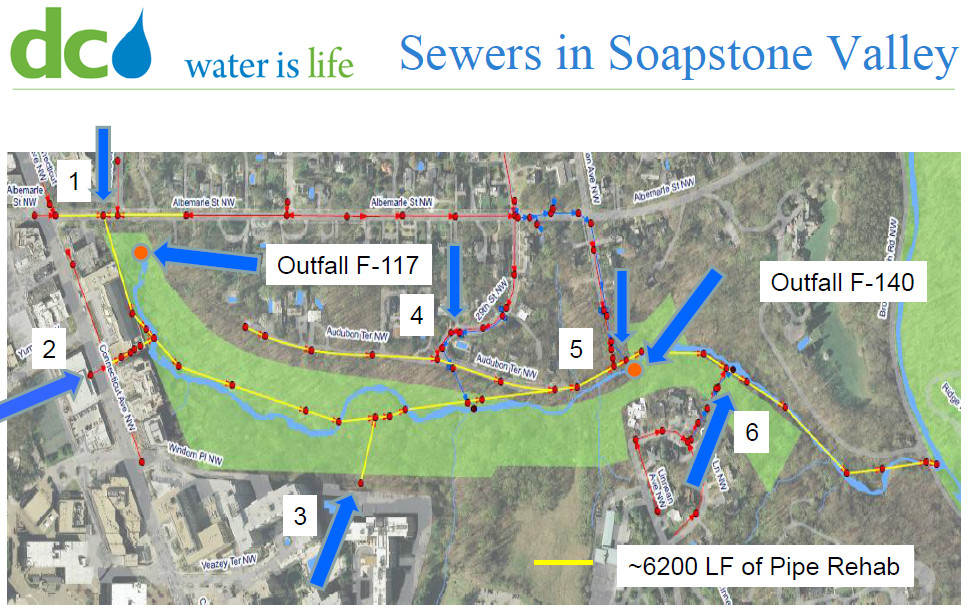
An inspector wearing high boots might conceivably have walked upstream in the creek, heading toward the the next outfall (F-117, near the trailhead), and spotted oozing in the creek bank near an un-permitted, suspicious corrugated pipe.
Q. With warning signs at the Albemarle trailhead taken down, is the larger source of pollution upstream resolved?
A. As of the community meeting on July 28th, the source had not been located and the problem remained although signs has been taken down. Stay tuned for a followup story.

Discover more from Forest Hills Connection
Subscribe to get the latest posts sent to your email.